
The Complex Omnichannel Messaging Product that Resulted in a 300% Lift in Engagement and a Brand Experience People Could Trust

Industry: Financial Services/Fintech
Product: Omnichannel Messaging Strategy, Design, and Development
Role: Creative Director
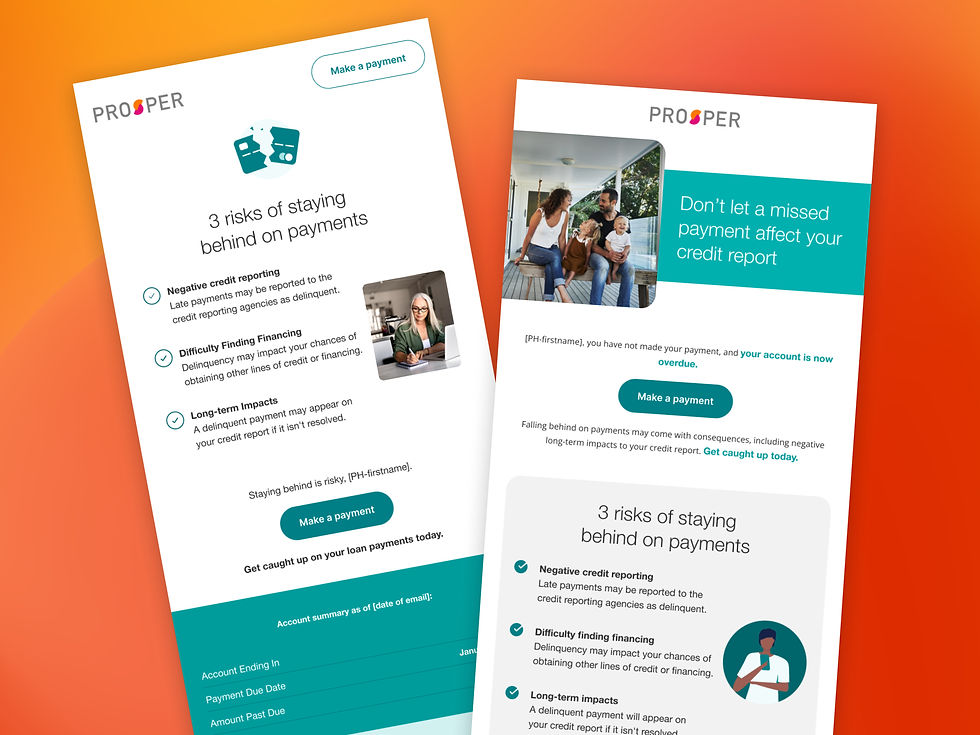
Fintech collections customers were unresponsive and millions of dollars was being left on the table. By connecting brand strategy, messaging, experience design, and the systems behind them, I helped turn a complex financial message into a clearer, more cohesive customer experience that contributed to $13M+ in revenue impact.
The Problem
The omnichannel messaging product made sense inside the business. To customers, it was much harder to understand.
Product features, financial terminology, marketing messages, and customer communications were coming from different teams with different priorities. Customers had to work too hard to understand what the product was, why it mattered, and what they should do next.
It wasn’t just a messaging problem. It was a systems problem.
But this wasn’t just a messaging problem. It was a systems problem.
The way teams worked internally was showing up in the customer experience externally.
The Opportunity
I started by looking at the whole experience—not just the interface or campaign.
Where was the story getting lost?
What did customers actually need to understand?
Where were internal decisions creating unnecessary complexity?
And how could we solve the immediate problem in a way that would make future work easier, too?
That changed the assignment from redesigning individual touchpoints to creating a clearer system for how the product was understood, communicated, and experienced.

The Strategy
Make the complex easier to understand
I reframed the product story around the questions customers were actually trying to answer—not the terminology the business used internally.
Information was simplified, prioritized, and introduced at the right point in the journey so customers didn't have to understand everything at once.

Make the experience match the story
Messaging alone couldn't fix the problem.
I connected the new strategy across email, sms, information architecture, interface design, content hierarchy, and digital touchpoints so the experience reinforced the same story at every step.
The goal wasn't simply to make things look better.
It was to make the next step easier to understand.

Get the organization telling the same story
Customer inconsistency usually starts internally.
I worked across product, marketing, operations, compliance, and business stakeholders to establish shared priorities and create greater alignment around what we were communicating and why.
That gave teams a clearer framework for making decisions—and customers a more consistent experience.
Build it so we didn't have to solve the same problem twice
The work became more than a redesign.
Instead of repeatedly fixing individual touchpoints, we built a stronger system behind them.
We created reusable messaging patterns, experience principles, components, and ways of working that could extend across products and future customer communications.
Instead of repeatedly fixing individual touchpoints, we built a stronger system behind them.
Results
The result was a clearer customer experience and a better way of delivering it.
Customers could understand the product faster. Teams had greater alignment around the story. And the organization had a more scalable foundation for creating future experiences.

Comments